Define the SKU before requesting price
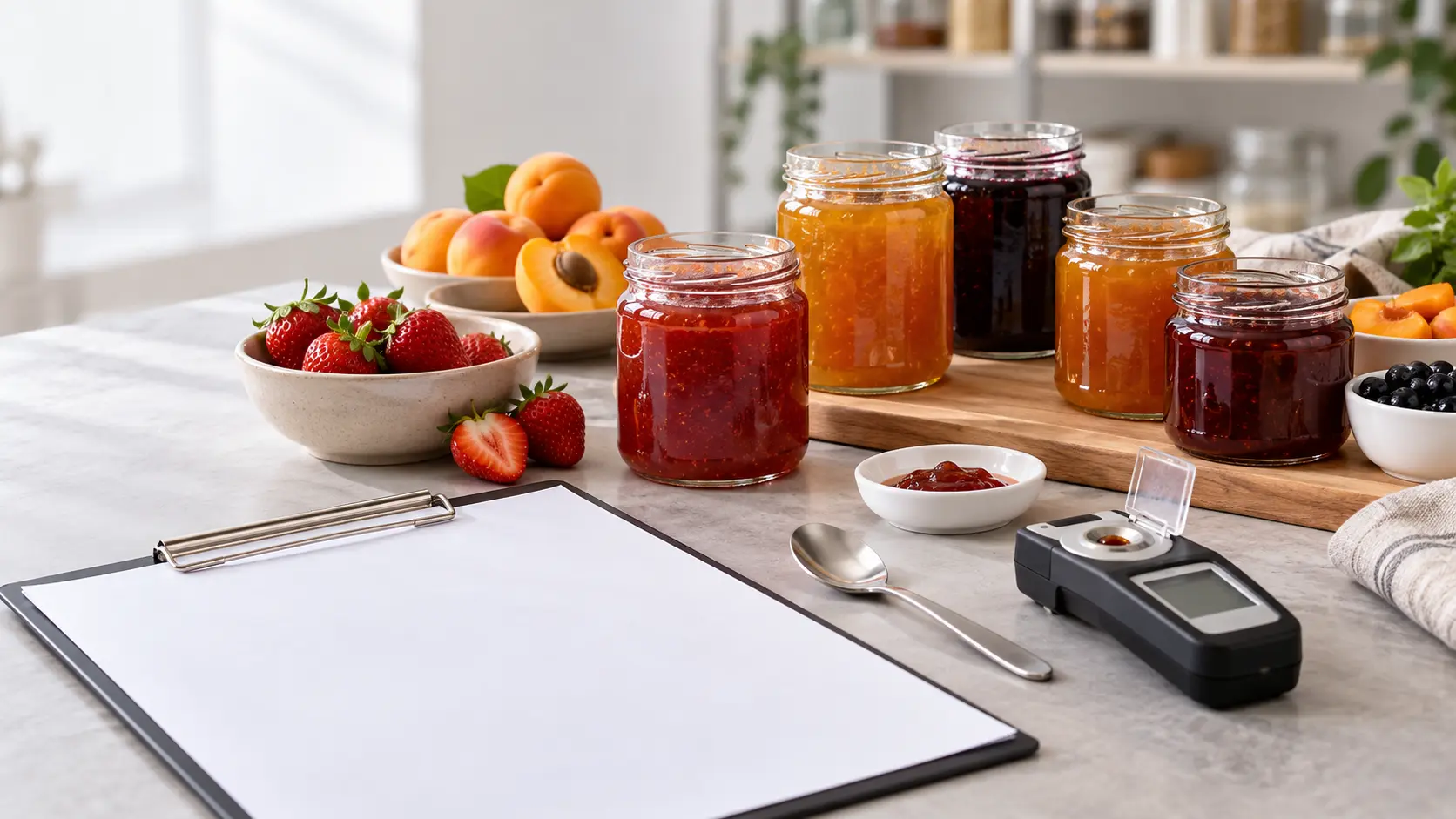
“Private-label jam” is not yet a quotation unit. Name the fruit or fruit blend, intended legal product name, sales country, retail or food-service use, pack size, target sensory profile and whether pieces, seeds or peel are expected. State if the proposal is for jam, extra jam, jelly, marmalade or another fruit spread; those names may carry different composition rules. Do not assume that a supplier's catalogue image proves the recipe, available stock, minimum quantity, certification or delivery time.
Place the project within a relevant sauces and preserves buying programme, then give each flavour and pack its own SKU code. A strawberry recipe in a 370 g jar and an apricot recipe in a portion cup should not share one specification merely because both are preserves.
Separate fruit input, recipe and finished-product data
Ask for three linked records: the fruit-input statement, the complete recipe and the finished-product specification. The first should state fruit species and form—pulp, purée, juice, concentrate or pieces—and the quantity used per 1,000 g of finished product under the applicable calculation. The recipe should identify sugars, pectin, acids, permitted preservatives or colours and processing aids where disclosure is required. The specification should record soluble solids, pH where controlled, sensory limits, net quantity, shelf life, storage and lot coding.
For EU projects, Directive (EU) 2024/1438 amended the jam rules and required Member States to apply implementing measures from 14 June 2026. Its general minimum fruit input became 450 g per 1,000 g for jam and 500 g for extra jam, with product-specific exceptions. Buyers should confirm the destination Member State's current implementing law, the exact fruit and the reserved name before approving artwork. The Codex CXS 296-2009 standard for jams, jellies and marmalades supplies useful international definitions, but it does not replace destination law or the signed SKU specification.
Match claims and tests to the exact product
Do not compare a Brix figure without its method, sampling point and temperature correction. Ask which production control is used, what finished-product tolerance is proposed and how an out-of-range batch is handled. If the offer mentions microbiological, contaminant or shelf-life testing, request the product code, lot, method, laboratory, dates and acceptance criteria. A factory certificate and a product test answer different questions.
Claims need the same discipline. Under EU Regulation (EC) No 1924/2006, “with no added sugars” and “reduced sugars” have defined conditions; a recipe change or fruit concentrate can affect whether wording is permitted. Treat “natural”, origin, vegan, organic, allergen-free and similar statements as proposed claims until the responsible operator has checked the recipe, process, evidence and destination rules.
Approve the jar, closure and transport pack
Specify container material, brimful and nominal capacity, net quantity, headspace, closure type, tamper evidence, label area and coding position. For glass, agree visual defect limits and how closure security, leakage, thermal damage and fill consistency will be checked. Ask for food-contact documentation appropriate to the materials and market; the EU framework reference is Regulation (EC) No 1935/2004.
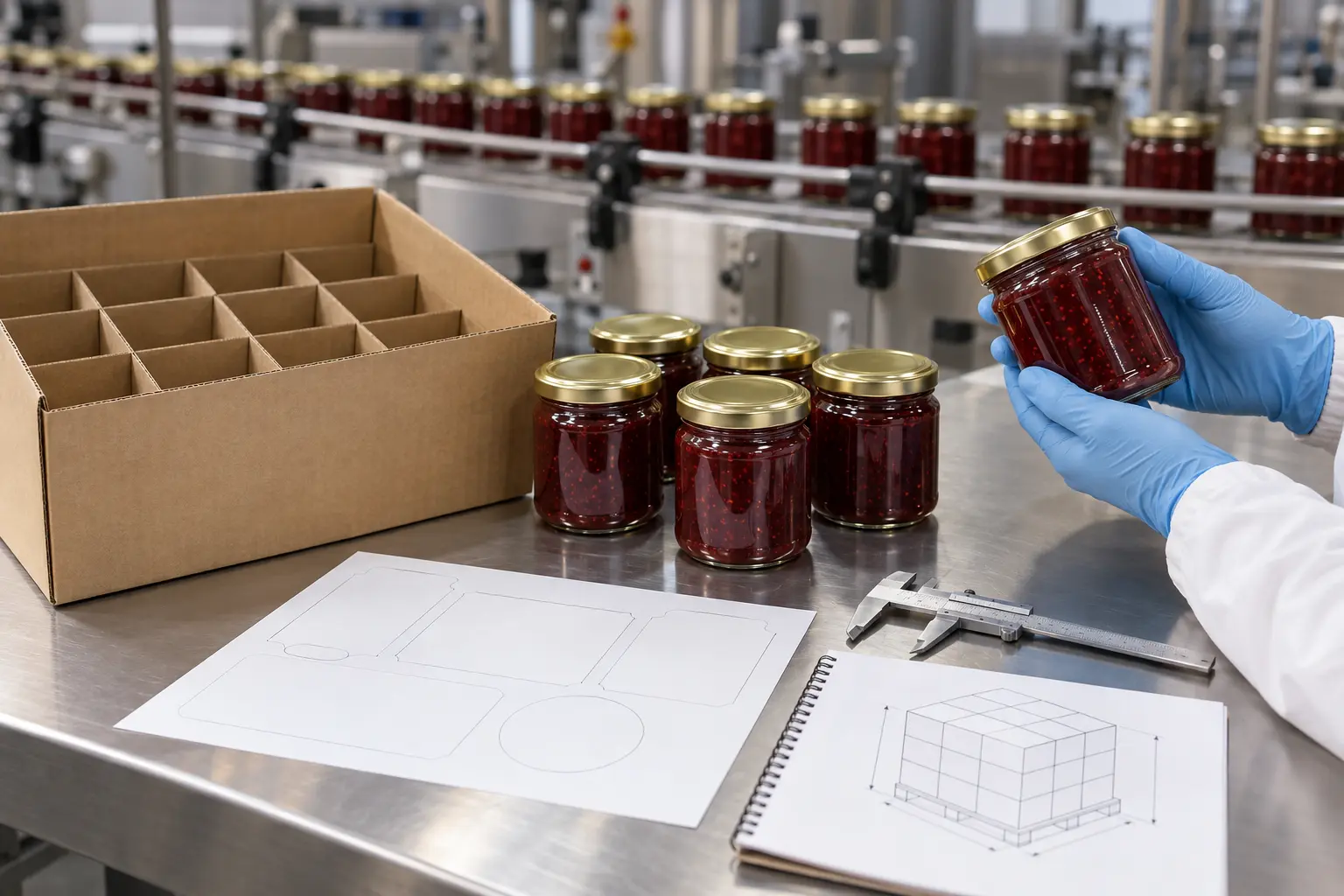
Then lock units per tray or carton, divider design, carton dimensions, gross weight, pallet pattern and storage constraints. Test the proposed retail and transport packs together. A jar that survives a bench review may still scuff labels, loosen closures or break when the real carton, pallet and route are introduced.
Build the destination label from verified data
Start artwork only after the recipe and legal name are stable. For EU prepacked food, Regulation (EU) No 1169/2011 provides the core mandatory particulars. Reconcile the food name, ingredients, allergens, net quantity, date marking, storage and use instructions, responsible operator, nutrition declaration, lot code and any required origin information with the approved specification. Under the amended EU jam rules applicable from 14 June 2026, the fruit-quantity declaration must remain in the same visual field as the product name, in clearly visible characters. Directive (EU) 2024/1438, Article 3(1)(c)–(d), removed the separate total-sugar declaration formerly required by the jam directive; the applicable nutrition-declaration rules under Regulation (EU) No 1169/2011 still apply. Confirm language and national presentation rules in the country of sale.
Use the private-label workflow to assign ownership of recipe, translation, dieline, barcode, print proof and change control. Keep the final artwork version tied to the matching SKU, sample and specification.
Send one comparable buyer checklist
Give every candidate the same table: SKU and destination; legal product name; fruit species and form; fruit input per 1,000 g; full recipe and additive function; soluble-solids method and tolerance; pack and closure; label languages and claims; case and pallet data; shelf-life basis; sample route; available product-specific evidence; quotation validity; Incoterms® rule and named place; and confirmed lead time, minimum and price.
A concise request can say: “Please complete the attached private-label jam brief for [country]. Separate confirmed values from options, identify every document by SKU and production site, and flag any recipe or label point that still requires destination review.” Align the commercial fields with our export quote request guide. Price, stock, minimum quantity, certificates and schedule remain supplier- and order-specific until confirmed in writing.