Lock product identity before comparing price
Start by separating pure instant coffee from coffee-based mixes containing sugar, creamer, chicory, cereals or flavours. EU Directive 1999/4/EC treats coffee extract, soluble coffee and instant coffee as products obtained by extracting roasted coffee beans with water; dried coffee extract must contain at least 95% coffee-based dry matter. A three-in-one drink or coffee-and-chicory mix is therefore a different brief, ingredient list and cost structure.
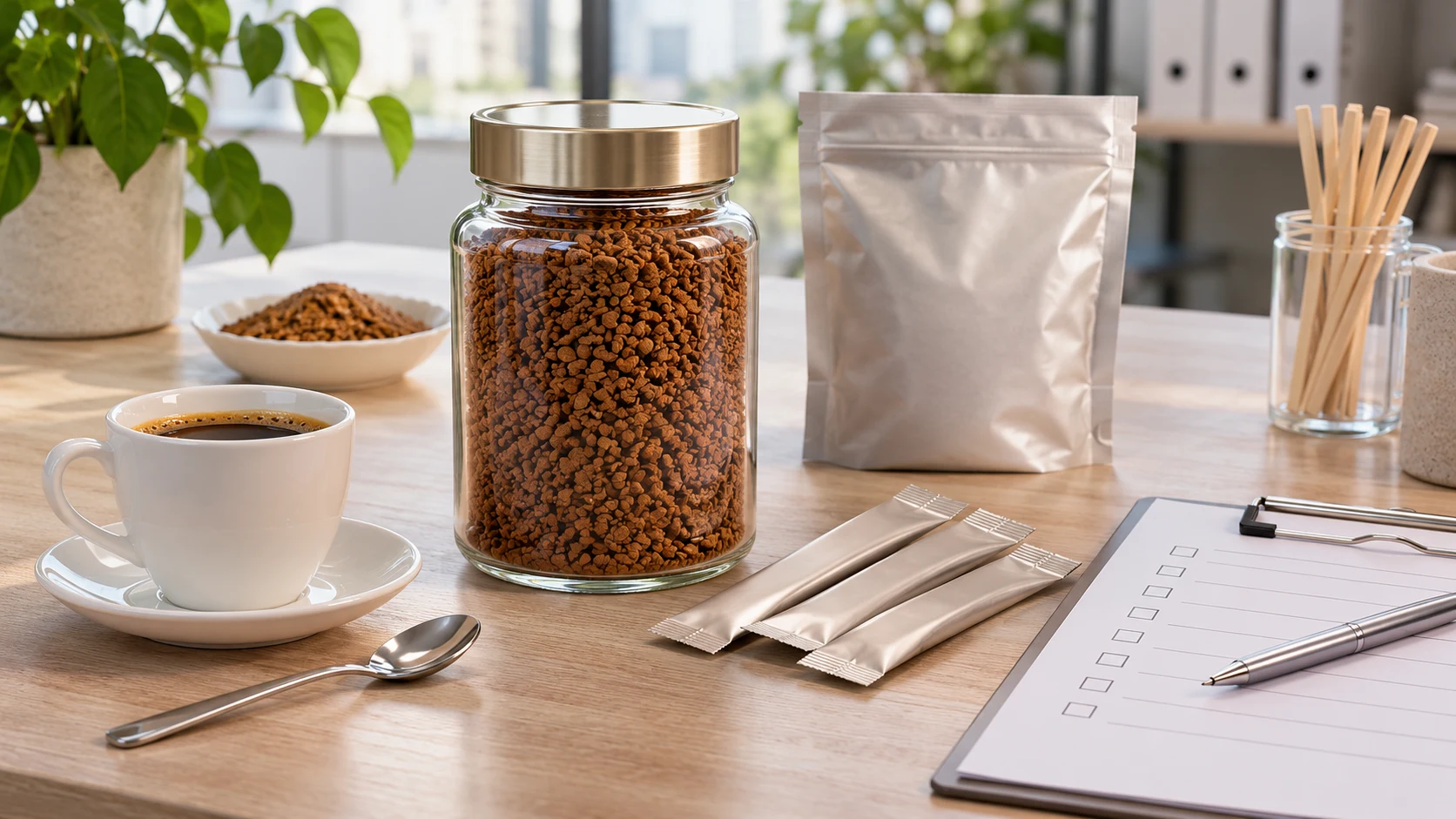
State whether the commercial format is spray-dried powder, agglomerated granules or freeze-dried pieces, but do not assume one process automatically means better quality. Record target markets, serving use, jar, pouch or stick-pack route, net quantity, expected consumption channel and whether the project uses an existing recipe or a controlled private-label adaptation. The beverages buyer page frames the category, while the private-label workflow assigns specification, sample, artwork and change-control responsibilities.
Build one measurable product specification
Request a product code and revision, declared coffee species or blend policy, origin statement policy, roasting and extraction route, granule appearance, bulk density, moisture, dry matter, solubility and sensory methods. Ask the bidder to state test methods, sampling frequency, release limits and what happens when a result is outside the agreed range. Do not invent a universal moisture, density or yield limit: the buyer and qualified producer should set values for the actual format and pack.
Link the approved specification to a signed sample, certificate of analysis template, ingredient statement, nutrition basis where applicable, allergen review, shelf-life protocol and change log. A new coffee blend, extraction site, carrier ingredient, aroma recovery step or packaging material can change the cup and the regulatory file even if the front label remains similar.
Run a controlled cup test, not an office tasting
Write one preparation protocol before samples arrive. Fix coffee dose, water mass, water temperature and hardness, vessel, stirring sequence, waiting time and number of repetitions. Use coded samples and score dry granule colour and aroma, dissolution time, surface foam, cup colour, aroma, acidity, bitterness, body, aftertaste and visible sediment. If the product is intended for iced drinks, test the declared cold-use method separately rather than extrapolating from a hot cup.
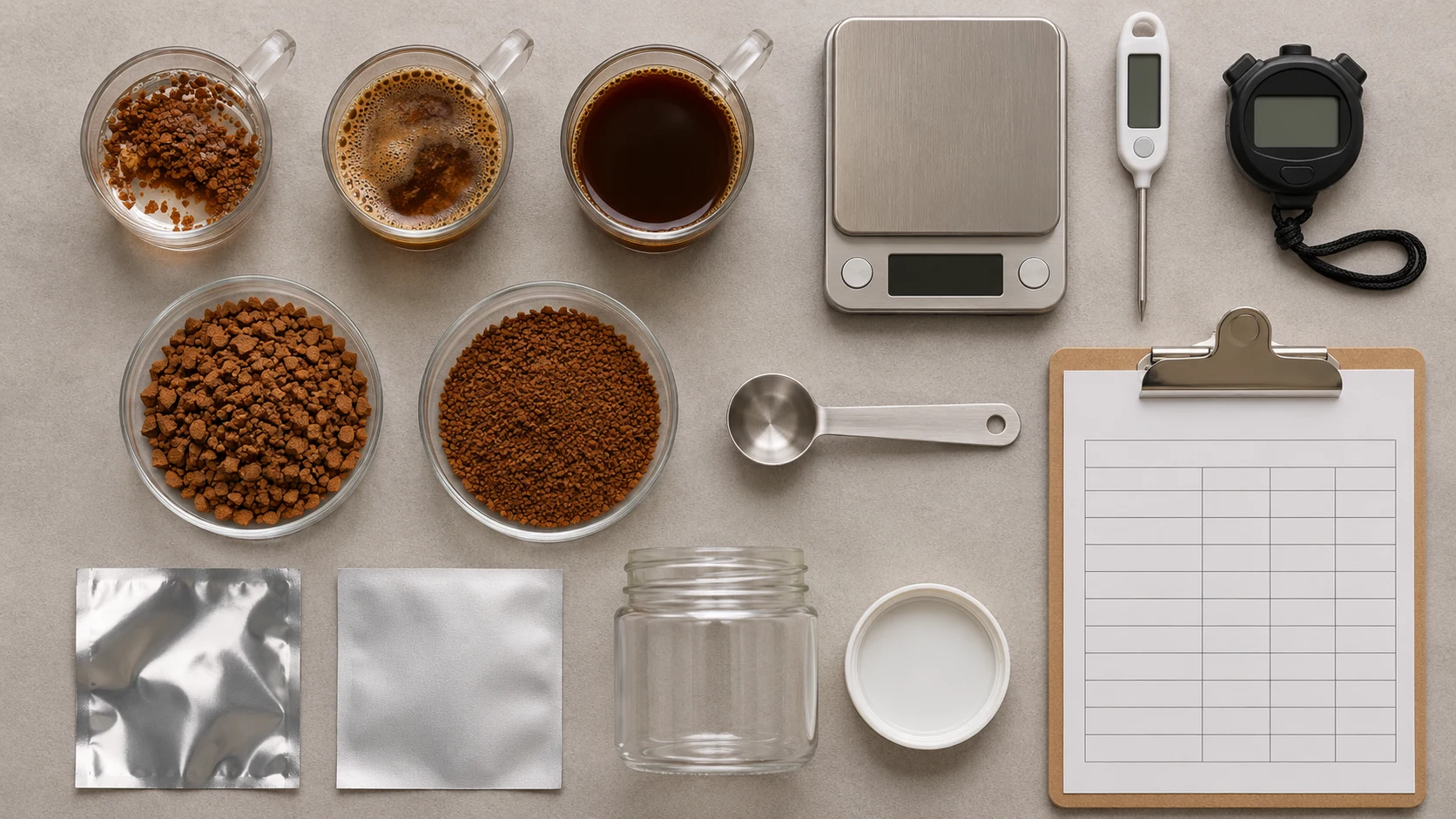
Compare the final product after defined storage in the final pack, not only a fresh laboratory sample. Record panel training, reference sample, pass criteria and allowed variation. Sensory preference alone should not substitute for identity, compositional, contaminant or packaging checks, and a photograph cannot prove commercial stock or certification.
Check EU identity, labels and acrylamide controls
Map the released product to Directive 1999/4/EC and the final destination label to Regulation (EU) No 1169/2011. Confirm the exact legal name, ingredients where required, net quantity, date and storage information, responsible food-business operator details, nutrition declaration when applicable, destination language and any origin or voluntary claim. Have the responsible importer review the final artwork for each market before printing.
Regulation (EU) 2017/2158 includes instant coffee in its acrylamide mitigation framework and lists a benchmark level of 850 micrograms per kilogram. That benchmark is a process-verification reference, not a blanket legal maximum or a product guarantee. Ask for the operator's mitigation measures, sampling and analysis plan, recent trend data for the proposed product and documented action rules when results exceed the benchmark. Do not turn one laboratory result into a permanent claim.
Validate moisture, oxygen and closure control as one system
Instant coffee can lose aroma or clump if the product-pack system is unsuitable. Define the primary material, barrier construction, seal or induction liner, closure torque, tamper evidence, coding area, secondary case and pallet pattern. For sticks or pouches, control laminate specification, seal window and leak method; for jars, control headspace, liner, opening performance and reclosing.
Regulation (EC) No 1935/2004 provides the EU framework for materials intended to contact food. Obtain declarations and supporting information for the actual material set and intended use, then verify migration and other requirements with the responsible market specialist. Support the requested shelf life with real-time or justified accelerated work on the final product and pack, including moisture, oxygen, seal integrity, aroma and reconstitution checks under defined storage and transport conditions.
Send one comparable RFQ matrix
- Destination, channel, pure instant coffee or mix, process format, serving use and net quantity
- Product revision, blend and origin policy, physical methods, sensory protocol and release limits
- Signed sample, certificate template, shelf-life study, traceability and change-control route
- EU legal name, label languages, operator details, claims review and acrylamide-control evidence
- Jar, pouch or stick specification, food-contact file, seal tests, case and pallet data
- Quantity by SKU, named delivery place, price basis, minimum order, lead time, validity and deviations
Require every bidder to complete the same matrix and keep technical approval separate from commercial comparison. The export quote request guide structures delivery terms and included documents. Submit the controlled brief through the Marnivo inquiry form for a case-specific sourcing review.