Define the food before comparing prices
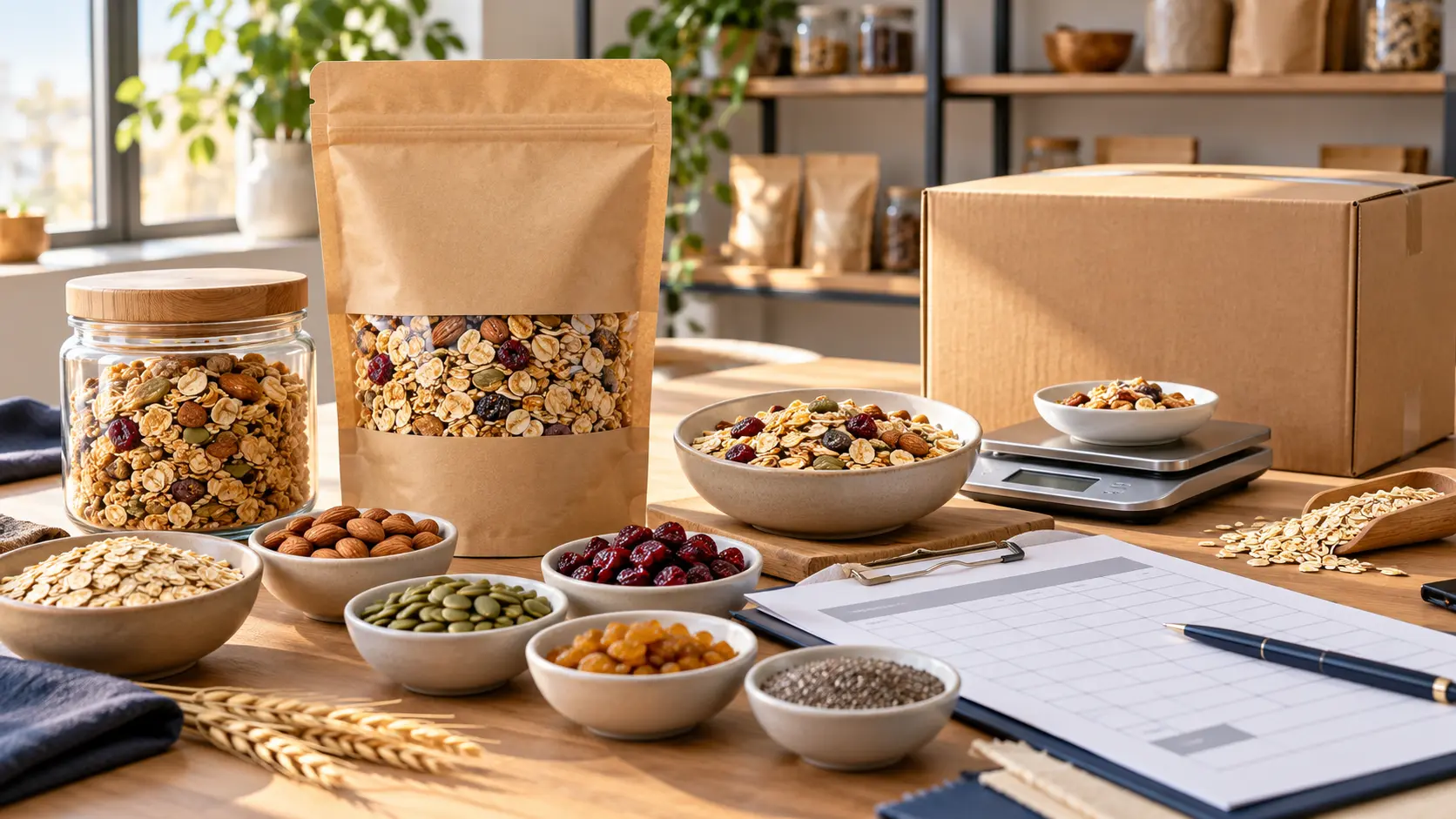
Granola and muesli are not interchangeable commercial descriptions. State whether the target is toasted clusters, an untoasted loose blend or another presentation, then freeze the recipe basis: cereal species and form, sweeteners, oils, nuts, seeds, fruit, chocolate or other inclusions, flavouring, added nutrients, particle range and target serving. Record the origin of each priority ingredient, the manufacturing location and the packing location separately; a Turkish supplier address does not prove the origin of every component.
Ask bidders to complete one controlled formula and specification rather than answer with a marketing sheet. Include percentage bands for headline ingredients, permitted substitutions, cluster-size distribution, broken material, fines, foreign material, colour, flavour, aroma, moisture or water-activity target, bulk density and shelf-life basis. The grocery staples buyer page places the item in the wider assortment, while the private-label workflow assigns artwork, sample and change-control responsibilities.
Turn every inclusion into a measurable requirement
Whole almonds, chopped nuts, seeds, raisins and dried fruit behave differently in mixing, baking and storage. Define the declared inclusion, cut or grade, size distribution, colour, permitted defects, stickiness, hard pieces, stones, stems, shell fragments and other foreign-material limits. For fruit and nut components, ask how suppliers, harvest or crop references and incoming lots are approved and linked to the finished batch.
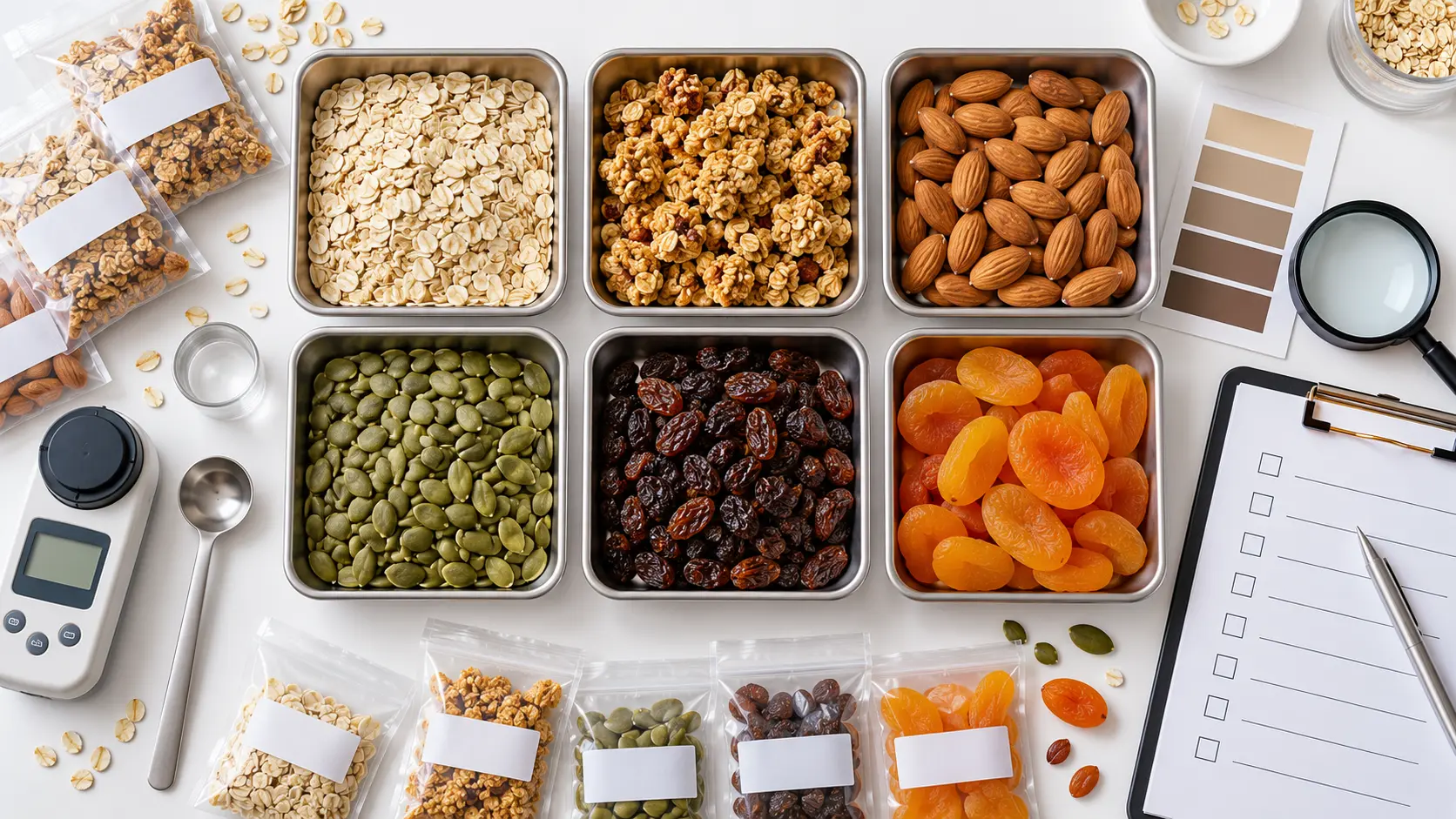
Compare samples using the same mixing and portion method. Record total inclusion percentage and distribution across replicate portions, cluster size, loose fines, dust, colour, aroma, texture and any oil migration or fruit hardening during the agreed storage check. A visually attractive top layer must not conceal uneven distribution within the pouch. Agree the test method, sample number, tolerance and decision rule before selecting a reference sample.
Control allergens, nutrition data and voluntary claims
Regulation (EU) No 1169/2011 governs mandatory food information and the declaration and emphasis of listed allergens. Map cereals containing gluten, nuts, sesame, milk, soya and any other relevant recipe or cross-contact hazard from receipt through rework, cleaning, packing and label release. Request the site's documented risk assessment; do not convert a precautionary allergen statement into a substitute for segregation and verified controls.
Approve nutrition values and front-of-pack language from the final recipe and a documented calculation or analysis plan. Under Regulation (EC) No 1924/2006, nutrition claims such as fibre or protein claims are subject to defined conditions. Require the buyer's regulatory reviewer to confirm the exact wording and supporting values for the destination market. Do not infer a claim from oats, nuts or seeds appearing in the recipe.
Link the process to risk-based analytical evidence
Under Regulation (EC) No 852/2004, food businesses apply hygiene requirements and procedures based on HACCP principles. Ask for the process flow, supplier approval, sieving and foreign-material controls, allergen changeover, heat profile where used, cooling, metal detection or other relevant control, hold-and-release status and deviation handling for the proposed line.
Regulation (EU) 2017/2158 establishes acrylamide mitigation measures and benchmark levels, including categories for breakfast cereals other than porridge; the predominant cereal and product construction affect the applicable category. Confirm scope with the responsible reviewer instead of assuming every granola or muesli uses the same benchmark. Build the broader plan from exact ingredients and process: current pesticide MRLs under Regulation (EC) No 396/2005 and applicable contaminant limits under Regulation (EU) 2023/915. Define sampling point, method, reporting limit, reviewer and response to a non-conforming result.
Approve the label and pack as one system
Review the final legal name, ingredient order and percentages where required, emphasized allergens, net quantity, date marking, storage, responsible operator, nutrition declaration, instructions, destination language and every voluntary claim. Match artwork to the approved formula and create a controlled check for recipe, label and code at line start and changeover. Any origin wording must be supported for the precise claim rather than inferred from manufacturing in Türkiye.
Specify pouch or carton material, barrier target, closure, seal checks, coding position, case configuration and transport test. Request suitability evidence for the intended food contact under Regulation (EC) No 1935/2004. Link ingredient lots, process records, finished codes, retained samples and dispatch units under the traceability duties of Regulation (EC) No 178/2002.
Send one comparable granola and muesli RFQ
- Destination, channel, product style, recipe, headline-ingredient percentages and proposed claims
- Cereal, nut, seed and fruit identity, grade, origin evidence, substitutions and supplier approval
- Cluster and particle distribution, fines, foreign-material limits, moisture target and sensory criteria
- Allergen map, segregation, cleaning verification, rework rule, label release and change control
- Heat process, acrylamide review, pesticide and contaminant plan, sampling method and reviewer
- Pack material, barrier and seal criteria, coding, case configuration, storage and shelf-life basis
- Quantity, named delivery place, price basis, minimum order, lead time, validity and marked deviations
Require every bidder to answer on the same sheet and keep technical acceptance separate from commercial comparison. Use the comparable export quote guide for delivery terms and inclusions. Send the completed brief through the Marnivo inquiry form for a case-specific sourcing review.