Define the salt and its intended use first
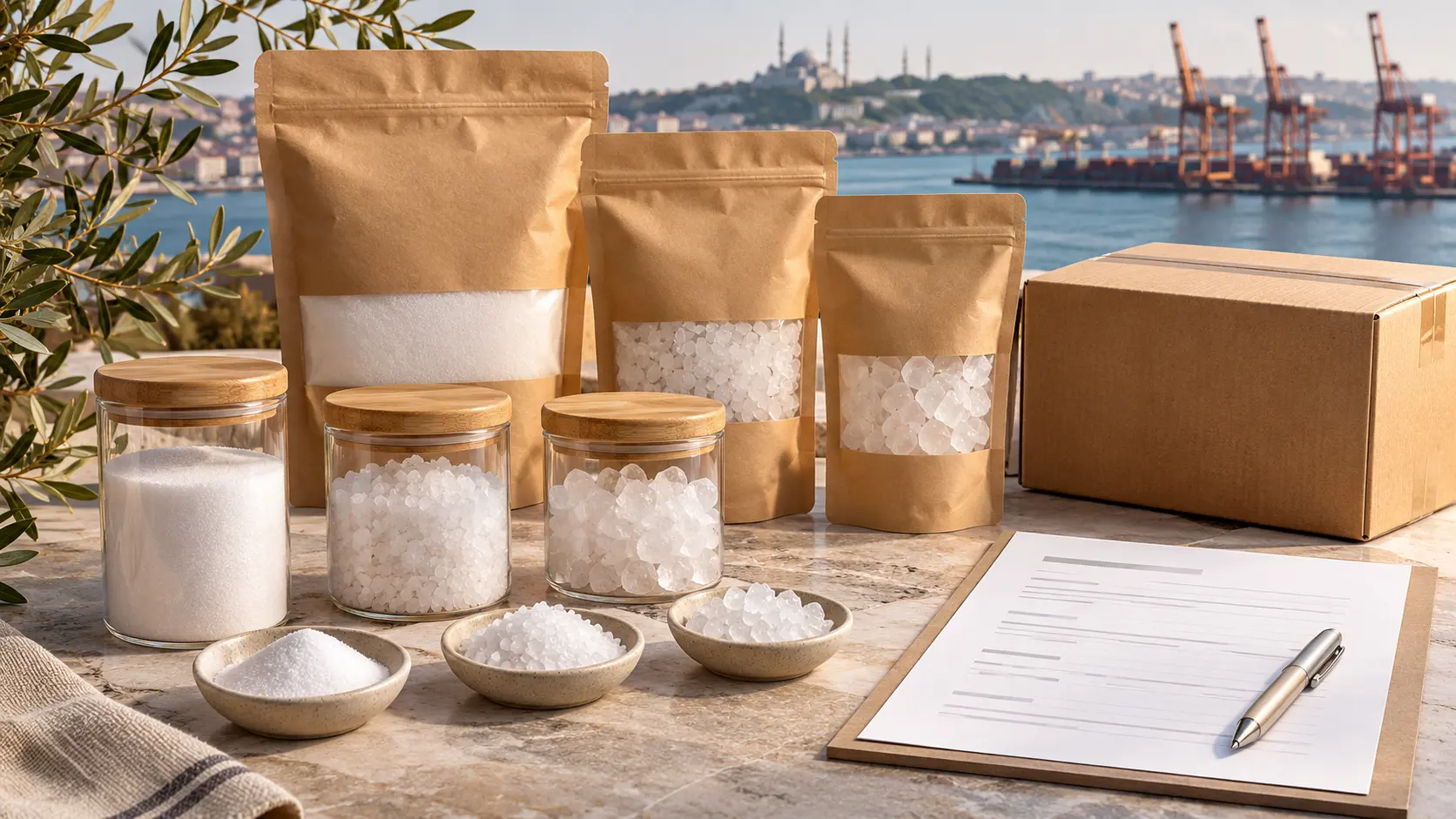
Start with food-grade salt, not an industrial-grade offer described only by colour or appearance. State the intended use—retail table salt, food manufacturing, bakery, seasoning blend or another application—and the destination market. Then record the salt source and production method offered, manufacturing and packing locations, crystal form, grain range, sensory expectations and pack format. A Turkish supplier or packing address does not by itself prove the geological or geographical origin of the salt.
Require one controlled specification for every quote. It should identify sodium chloride basis, moisture, water-insoluble matter, particle-size distribution, bulk density where operationally relevant, permitted foreign material, appearance, odour, taste, shelf-life basis and storage conditions. The grocery staples buyer page places salt in the wider assortment; the private-label workflow assigns responsibility for recipe, artwork, samples and change control.
Freeze the iodine and additive decision
Do not treat “table salt” as a complete recipe. State whether the target is non-iodised, iodised or another fortified presentation. Where iodine is requested, the brief must name the iodine compound, target at manufacture, tolerance, analytical method, shelf-life expectation and who verifies destination-market requirements. National rules and public-health programmes can differ, so neither the presence nor the absence of iodine should be assumed from an EU destination alone.
List every anti-caking agent or processing aid proposed and require the supplier to mark any deviation. The current Codex Standard for Food-Grade Salt, CXS 150-1985, amended in 2025, links salt additives to the Codex General Standard for Food Additives. For an EU offer, the responsible reviewer should also confirm the exact substance, function and conditions of use against Regulation (EC) No 1333/2008 and the destination version in force. A supplier certificate or familiar E-number is not a substitute for this product-specific review.
Make particle control and sample approval measurable
“Fine”, “coarse” and “crystal” are commercial descriptions, not acceptance criteria. Define sieve sizes, percentage retained or passing at each point, maximum oversized pieces and fines, and the agreed test method. Add flow, caking, dissolution or dosing checks only when the end use makes them relevant. For transparent packs, define the visual defect and foreign-material decision rule; do not accept a hand-selected photo as evidence for the production lot.
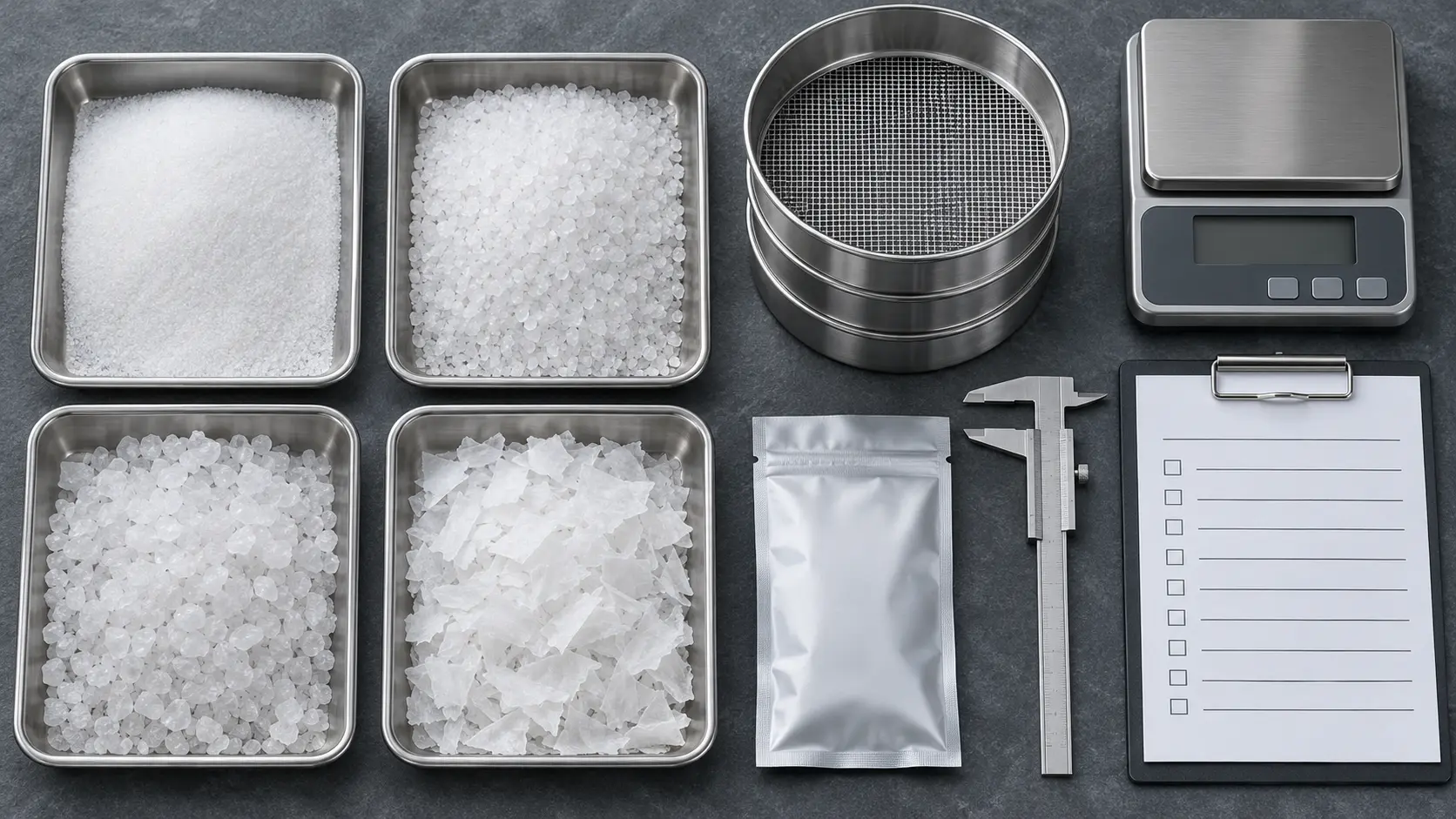
Agree who draws samples, from how many units and at which stage. Record composite or individual testing, sample mass, sealing, retained-reference period and action after a failed result. Compare bidders with the same method and store the approved reference in a way that prevents moisture uptake. Link the sample code to the formula, specification, artwork version and proposed production site.
Match hygiene and analytical evidence to the risk
The Codex salt standard covers composition, contaminants, hygiene and labelling at an international reference level; it does not turn a quotation into proof of conformity. Under Regulation (EC) No 852/2004, food businesses apply hygiene requirements and procedures based on HACCP principles. Request the process flow, supplier approval, foreign-material controls, equipment cleaning, pest control, hold-and-release status and deviation handling for the proposed line.
Build the analytical schedule from the exact source, process, additives, pack and destination. Specify analyte or quality attribute, method, sampling point, frequency, reporting limit where relevant, acceptance rule, reviewer and response to a non-conforming result. Do not demand an undifferentiated bundle of certificates, and do not infer current certification, regulatory acceptance or shipment readiness from a sample report.
Approve label, moisture barrier and traceability together
Review the legal food name, ingredient declaration where applicable, net quantity, date marking, storage, responsible operator, nutrition treatment, instructions, destination language and every voluntary origin or quality statement under Regulation (EU) No 1169/2011. Confirm any exemption or special treatment for the exact presentation instead of copying a competitor label. Origin wording must match documented facts about the salt and packing operation.
Salt readily takes up moisture, so specify pack structure, barrier target, closure, seal checks, coding position, case configuration and transport test for the chosen climate and route. Request suitability evidence for the intended food contact under Regulation (EC) No 1935/2004. Link source batch, processing or blending records, additives, packaging lots, finished codes, retained samples and dispatch units under the traceability duties of Regulation (EC) No 178/2002.
Send one comparable food-grade salt RFQ
- Destination, channel, intended use, food-grade identity, salt source and production and packing locations
- Non-iodised or iodised recipe, iodine compound and target, additives, tolerances and marked deviations
- Sodium chloride basis, moisture, insoluble matter, particle distribution, sensory and foreign-material criteria
- Sampling plan, methods, frequency, reporting basis, retained sample and non-conformity decision rule
- Hygiene controls, supplier approval, hold-and-release, change control and risk-based analytical evidence
- Pack material, moisture barrier, seal, coding, case configuration, storage and shelf-life basis
- Quantity, named delivery place, price basis, minimum order, lead time, validity and commercial exclusions
Require every bidder to answer on the same sheet and keep technical acceptance separate from commercial comparison. Use the comparable export quote guide for delivery terms and inclusions. Send the completed brief through the Marnivo inquiry form for a case-specific sourcing review.