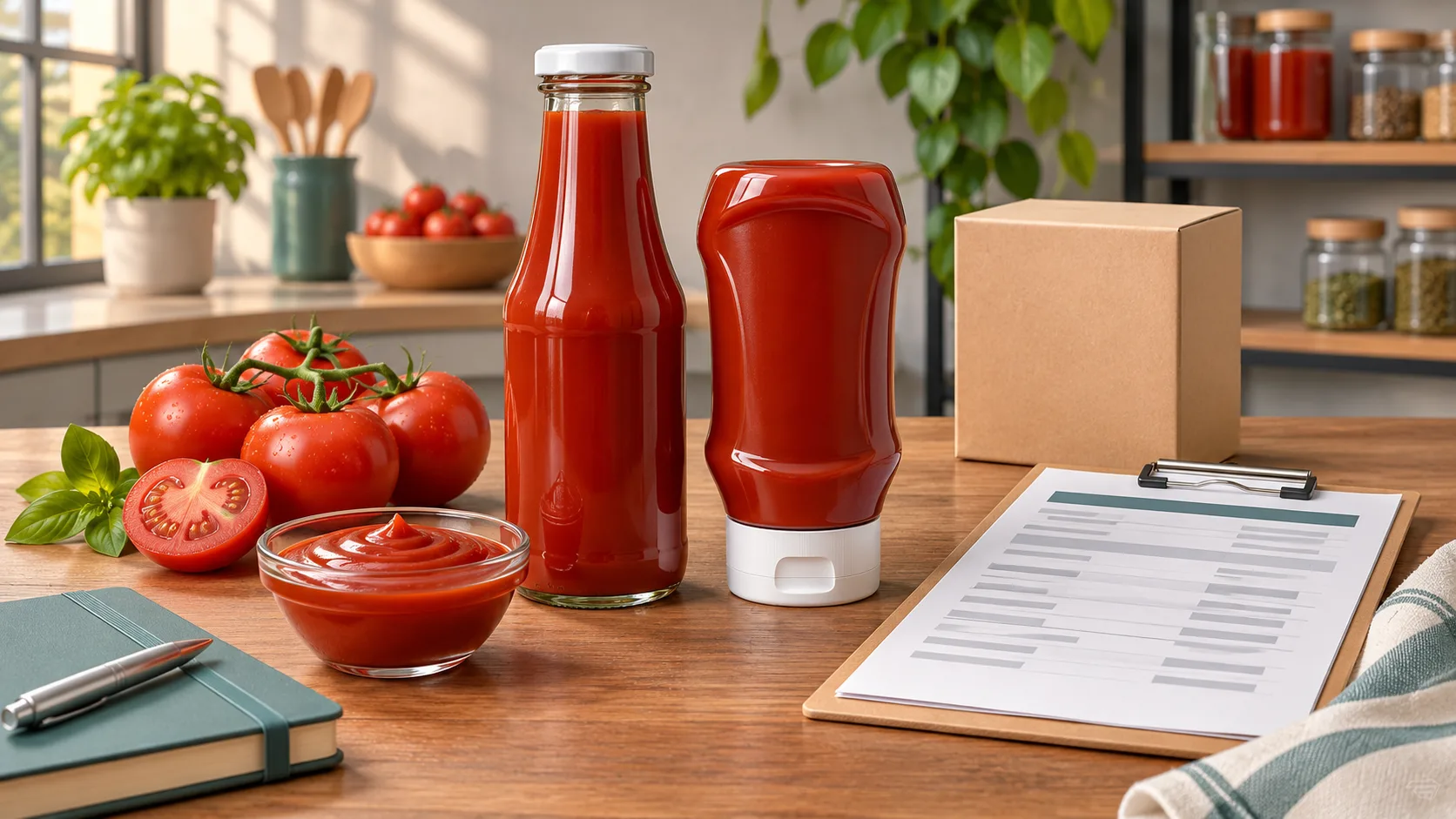
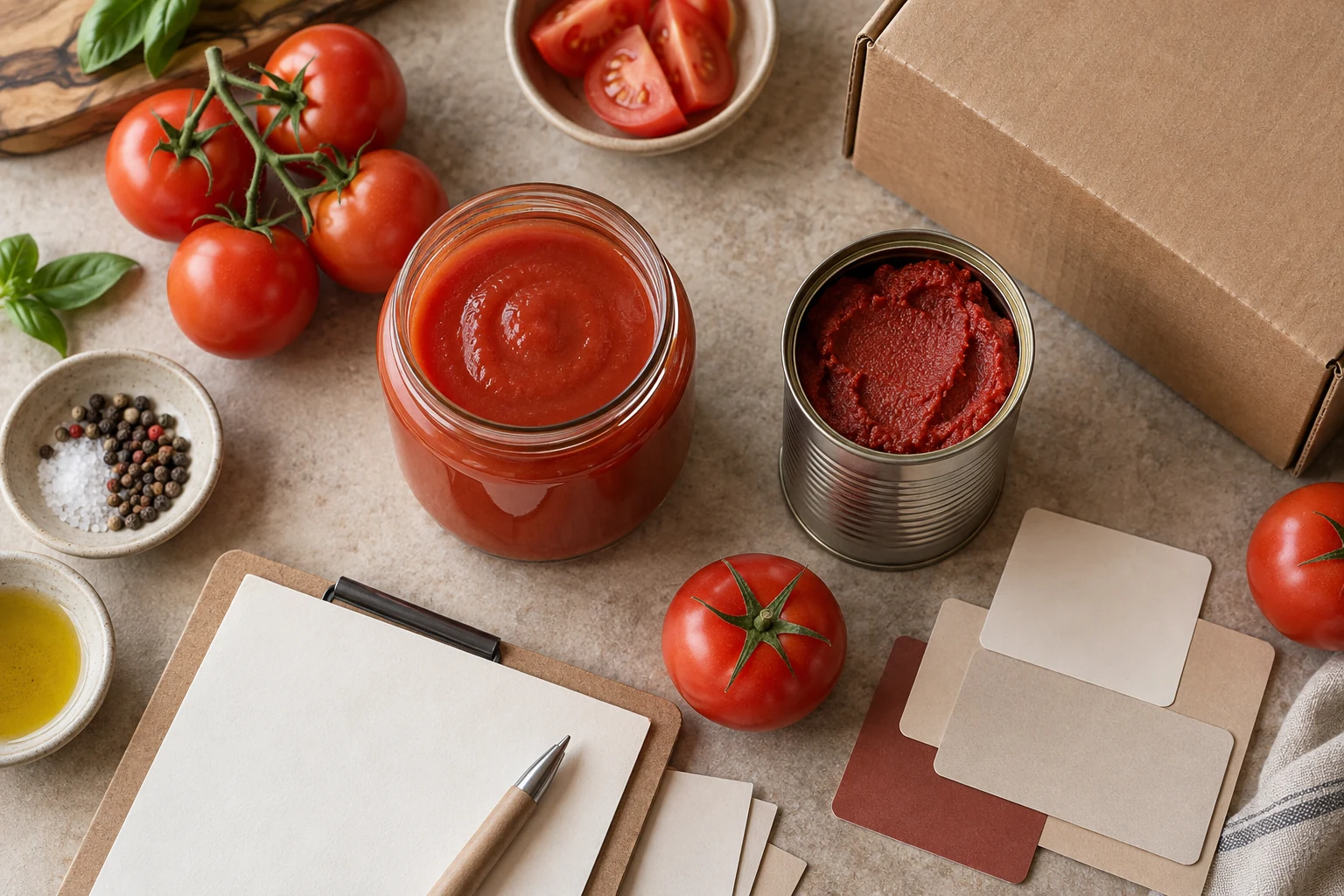
Tomato paste, cooking sauce and table sauce may sit in the same sourcing conversation, but they are not interchangeable buying specifications. Concentration, recipe, pack material, net content and intended use all change the comparison. An importer therefore needs one product brief per SKU before asking suppliers for a price. This guide helps buyers structure that brief; it does not imply that a product is available or approved for any market.
Define the product and sales channel
Start with the commercial use: retail, food service or industrial preparation. Then name the product as precisely as possible—tomato concentrate, seasoned cooking sauce or ready-to-use table sauce—and record the expected flavour profile, texture, permitted recipe alternatives and serving or production use. Add the destination country, brand route, consumer or food-service pack size and expected case format. Our sauces and preserves buyer page provides a useful category starting point.
For tomato concentrate, ask how the supplier defines and measures concentration, and request the value on the current product specification. The Codex Standard for Processed Tomato Concentrates (CXS 57-1981) can provide shared terminology, but it is not a substitute for the destination law, the agreed specification or product-specific evidence. For a sauce, list ingredients, any permitted additives, sensory target and whether the quoted sample uses the same recipe as the proposed production SKU.
Tie every claim to the exact SKU
Ask for a dated specification that identifies the product code, ingredient declaration, relevant analytical values, storage conditions, unopened shelf life and packaging configuration. If you need a claim about origin, allergens, diet, certification or production method, state it separately and ask what evidence applies to that exact article and site. A company certificate, catalogue statement or photograph should not be treated as proof for every product.
Agree the sample reference and approval process in writing. Record what may change between sample and production, who approves the change and which documents must be reissued. The Codex list also includes standards for preserved tomatoes and general food labelling; use such texts as comparison references, then confirm the binding rules in the destination market. Do not convert a general standard into an unsupported promise about a supplier.
Compare the full pack system
Specify the primary pack—such as a metal can, glass jar, pouch or food-service container—together with closure, lining or contact layer, net content and opening method. Then describe the secondary and transport pack: units per tray or carton, carton dimensions and gross weight, pallet pattern and storage limits. Ask for the declaration or evidence required in your market for materials that contact the food. In the EU, Regulation (EC) No 1935/2004 is the framework reference for food-contact materials.

Inspect sample packs for closure, leakage, corrosion, panel damage, label adhesion and coding legibility under the intended handling conditions. Define how damage will be recorded at the agreed handover point. For heat-processed canned products, the Codex codes of hygienic practice include product-process references; they support technical questions but do not replace the producer's validated process, the buyer's assessment or official control.
Approve the destination label
Reconcile the artwork with the approved recipe and specification before printing. Check the legal product name, ingredient list, allergens where applicable, net quantity, date marking, storage and use instructions, responsible business details, lot coding and any nutrition or marketing statements required for the destination. For EU retail, the European Commission's mandatory food information guide summarises the particulars for prepacked foods. Another market may require different wording, language or importer information.
If the product carries your brand, assign ownership and approval of the recipe, dieline, translations and print proof. Our private label process explains why these decisions should have named owners. Keep the approved artwork version with the matching product code, specification and sample reference so that a last-minute file cannot silently replace the reviewed one.
Request a commercially comparable offer
Send every candidate supplier the same SKU table and request the product-specific minimum, sample route, lead time, pack hierarchy, remaining shelf life at dispatch, available documents and quotation validity. Ask for the delivery term with a named place, not a three-letter abbreviation alone; the ICC Incoterms® resource explains the role of the named place. Compare the price per identical net quantity and case configuration, then model freight and handling separately.
A concise request might read: “Please quote one tomato paste SKU and one cooking sauce SKU for retail in [country]. State recipe and concentration references, net content, units per carton, pallet pattern, label languages, minimum remaining shelf life at dispatch and the named delivery place under the proposed trade term.” Replace every bracket with a decision or mark it open. EU buyers can use the Commission's Access2Markets guidance as an official starting point, then check the exact commodity code, origin and destination requirements.
Use one final approval checklist
Before ordering, confirm that the quote, specification, sample, recipe, artwork, primary pack and master carton all carry the same SKU reference. Record accepted tolerances, change control, lot coding, shelf-life points, inspection evidence and the named delivery place. Keep availability, minimum quantity, price, certification and lead time as supplier-specific confirmations—not assumptions from a category guide. A disciplined file set makes offers easier to compare and gives both buyer and supplier a clearer basis for resolving discrepancies.